

Organising your business in a way that reflects its customers’ journeys was the first step most organisations took a few years ago, in an attempt to move from efficiency-driven silos towards customer-centricity. But this was just that, the first step. Once these organisations started focusing and listening to customers again, they quickly realised their needs had moved on. Quite substantially. People are now looking for timely financial advice from their current account banks, a quirky living experience from their hotel room providers and a frictionless ride in a local personal car from their cab service. Such modern requirements pose an exciting challenge for organisations trying to scale and remain customer-centric at the same time.
The answer for many of these businesses is to move away from their traditional verticals and business models towards a customer journey-based structure. In this way, organisations can create specific teams solely responsible for certain areas of the customer experience – such as acquisition, onboarding, servicing or retention. This reorganisation allows for a far more agile and customer-centric approach. Moreover, it helps address the well-known challenges with the speedy delivery of customer value that large enterprises currently face.
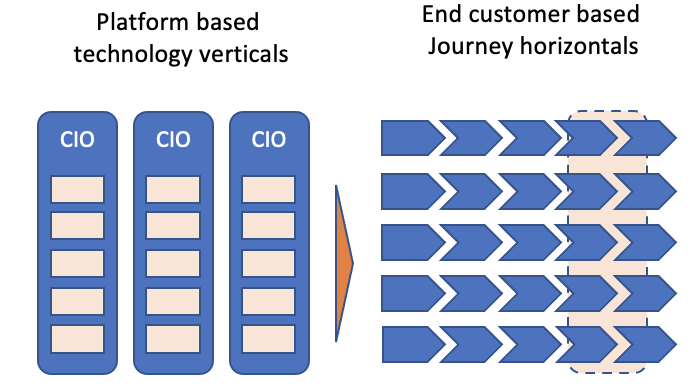
As customer journeys become more complex, so do the business platforms that support them. A few businesses have been able to make this move successfully. One of the most notable is Amazon, which has created an extremely complex platform that can support their multiple customer journeys – such as online shopping, digital content and cloud services. While these journeys are relatively independent of each other and hence can be developed and maintained quite efficiently on their own. For complex and regulated business functions like banking, the customer onboarding journey may not remain as independent as the customer servicing journey. Business services like KYC (Know your customer) need to be reused across such journeys. While this inefficiency might be acceptable to focus on customer value, the issue becomes more challenging when such services get developed in different ways by different journeys. This would confuse the end customer and hence impacts the experience and value, customer journeys intended to improve in the first place.
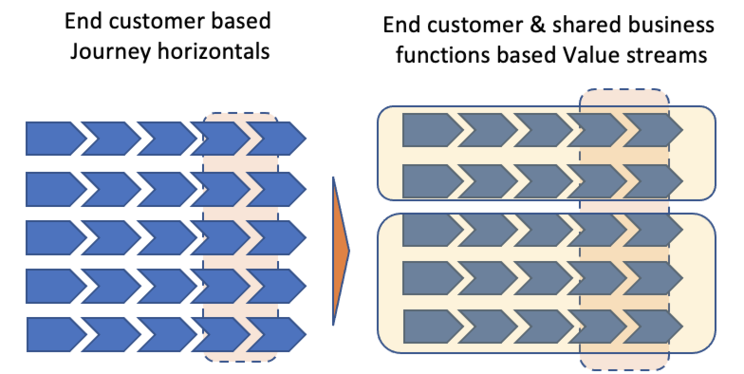
The next step in this structural transformation is to move from customer journeys to Value Streams. Value Streams combine all the end-to-end activities required to bring a product or service to the customer. A good example here would be an order-to-cash Value Stream for an e-commerce company which encompasses everything from when a customer searches and shops for a product to the fulfilment process and then eventually customer care if the customer has questions bout the product or when we want to build loyalty and increase the wallet share. Value Streams help identify and quantify the Value Contribution of each part of the process and can help you see where there are gaps or opportunities for improvement. The value streams built around customer journeys provide a great way to remain close to customers while being as efficient as possible without needing to duplicate business services or leaving massive handoff gaps to serve the customer quickly.
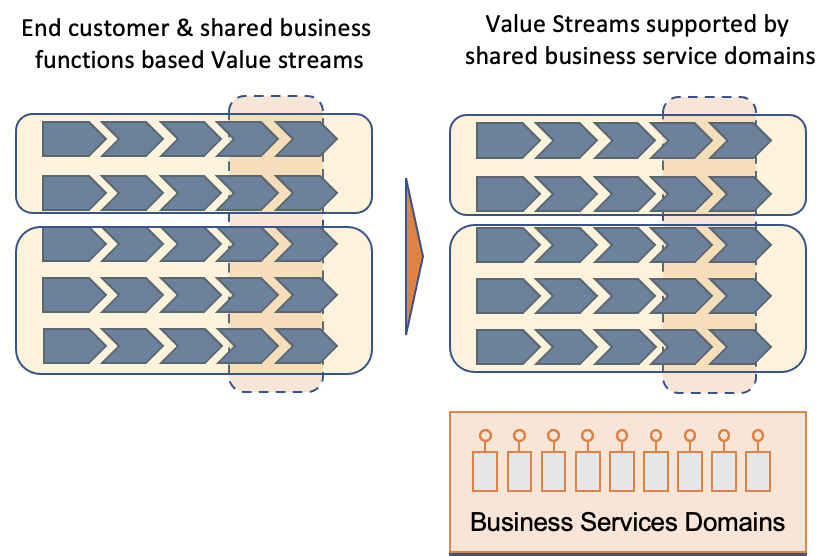
While this works great for serving currently known customer demand, this can come in the way to suit future customer needs. As the next step in the evolution of Value Streams and customer journeys, Business Platforms can help organisations identify new areas for growth and innovation. They act as a foundation that allows you to build an ecosystem of business capabilities that span the entire customer experience from awareness through purchase and post-purchase engagement.
Domain Tenant Models allow us to think about a business from business capabilities and a consumer perspective. For example, a business platform could be used to develop a new service for an existing customer or to create an entirely new product. For a retail banking business, for example, payment built as a domain service for existing savings and current account needs can easily be monetised by serving needs for other products and companies.
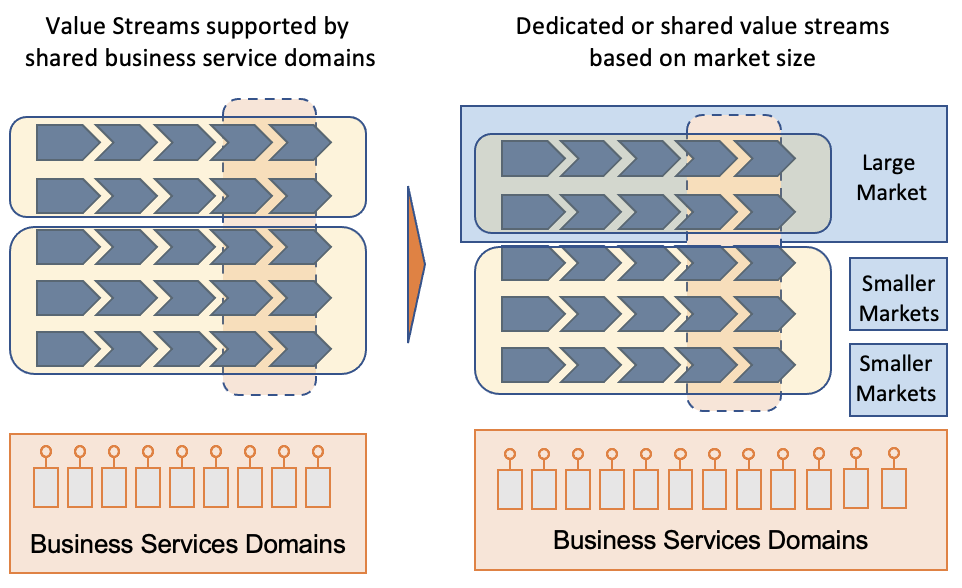
The domain tenant model serves as an excellent foundation for transforming and moving existing businesses towards a futuristic business platform model but becomes quite complex when such enterprises need to scale across multiple markets of varying sizes. The key to success with this model is adapting and responding to customer needs quickly. In addition, the platform must be able to support different channels, geographies, languages and currencies. One of the approaches in my experience have seen work well is that large markets have a dedicated domain team while smaller markets work with shared domain teams.
Most of the existing Scaled Agile frameworks do not fully serve large enterprises’ complex customer-centric and scaling needs. Whatever organisation design you chose from the above, putting that into operation would require putting into place a customised scaled agile delivery operating model considering current capabilities within the organisation supported by clear communication of change and creating an environment to support the change.